01
Discover
Understand the facility, project window, rack count, asset types, access restrictions, data sensitivity, and desired disposition path.

Controlled infrastructure retirement
Secure, documented data-center decommissioning, from rack-level inventory and controlled removal to sanitization coordination, transportation, and responsible disposition.
On-site labor from $50 per technician-hour
The hidden work
A completed decommission should leave more than vacant floor space. It should leave an intelligible record of what was removed, how sensitive media was handled, where equipment went, and what remains outstanding.
Which assets were removed?
Which drives contained data?
Who handled each device?
What was reused, recycled, transported, or destroyed?
What proof remains after the room is empty?
The controlled retirement system
Each stage turns physical work into defined inputs, controlled actions, and reviewable outputs.
See the complete process01
Understand the facility, project window, rack count, asset types, access restrictions, data sensitivity, and desired disposition path.
02
Create or validate the asset inventory. Identify servers, switches, storage, drives, rails, cables, PDUs, and dependencies before removal.
03
Coordinate shutdown, cable isolation, de-racking, hardware removal, packing, labeling, and cleanup using an agreed method of procedure.
04
Maintain tracking and handoff records. Apply the agreed sanitization, destruction, reuse, or recycling workflow to relevant devices and media.
05
Deliver a clear package showing completed work, asset outcomes, exceptions, supporting records, and unresolved items.
Service coverage
Capabilities can be combined around the facility, equipment, schedule, and evidence requirements. Inclusion is confirmed before work begins.
| Service capability | Initial scope | Field execution | Closeout output |
|---|---|---|---|
| Asset inventory | Validate or create | Update outcomes | Reconcile |
| Shutdown coordination | Confirm ownership | Follow authorization | Record exceptions |
| Cable mapping | Trace dependencies | Isolate and remove | Document residuals |
| De-racking | Plan sequence | Controlled removal | Confirm completion |
| Drive identification | Classify | Track custody | Match evidence |
| Packing | Define method | Protect and label | Handoff record |
| Transport coordination | Confirm destination | Stage handoff | Receipt where scoped |
| Reuse or recycling routing | Agree path | Separate streams | Provider evidence |
| Exceptions record | Open register | Update in field | Resolve or carry forward |
| Final report | Agree evidence | Capture records | Closeout package |

Chain of custody
Asset identity, media classification, handoff checkpoints, disposition instructions, verification, and exceptions can be aligned before the first device leaves its rack.

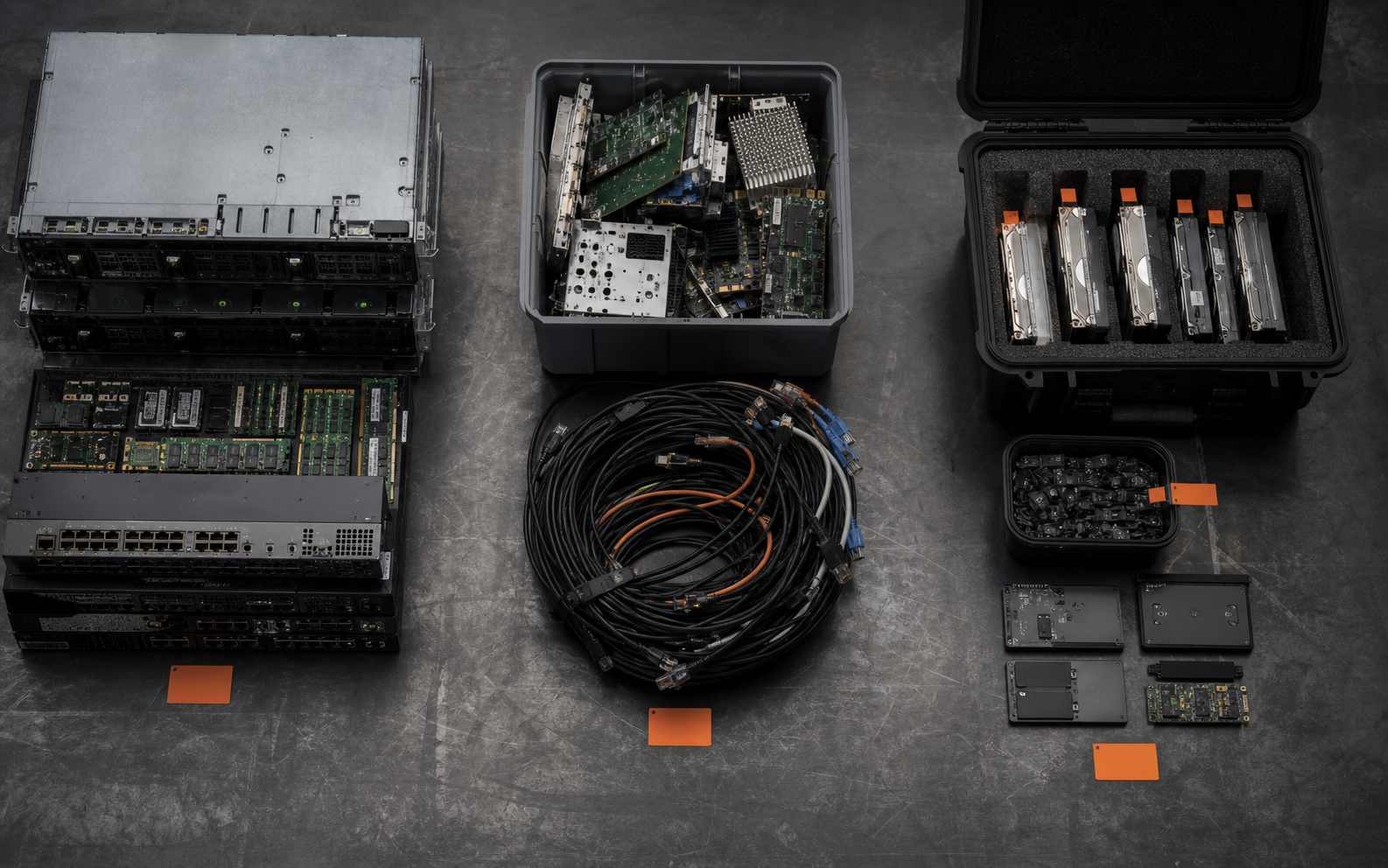
Shutdown authority, equipment ownership, packing method, destination, media handling, and acceptable evidence all shape the work.
Transparent engagement
The public rate is a useful planning baseline. The final scope reflects the conditions and services required to complete the project responsibly.
USD per technician-hour
Labor planner
$50 / technician-hourPlanning estimate only. It excludes transportation, equipment, materials, disposition charges, taxes, travel, and third-party services.
Project fit
Practical situations where inventory, timing, custody, and destination need to be resolved together.
Clear infrastructure against a lease, handback, or access deadline.
Remove redundant equipment while protecting live dependencies.
Retire displaced assets after replacement and migration.
Coordinate equipment, records, staging, and final cleanup.
Account for the hardware left after workloads move.
Identify data-bearing media and agree its next step.
Trace and remove switches, routers, rails, and cabling.
Prepare owned or leased equipment for its confirmed destination.
Separate active test assets from equipment ready to leave.
Define a repeatable evidence model across several locations.
Practical answers
A project can include assessment, inventory, shutdown coordination, de-racking, cable and accessory removal, media identification, packing, transport coordination, disposition routing, cleanup, and closeout reporting. The agreed scope determines what is included.
No. It is the public starting on-site labor rate per technician-hour. Transportation, equipment, packing materials, travel, disposal, recycling, after-hours work, taxes, and third-party services can be quoted separately after assessment.
Potentially, where the site owner approves the work method, access controls, isolation boundaries, safety procedures, and working window. Active-site requirements must be confirmed before scheduling.
Sanitization and physical-destruction coordination can be included in scope. The responsible provider, method, verification evidence, media type, and customer policy must be agreed before work begins.
Projects can use asset identifiers, working inventories, handoff records, exception logs, and outcome reconciliation. The exact evidence fields and custody checkpoints are defined in the project scope.
Yes, reuse, return, resale preparation, or another customer-defined destination can be part of the disposition plan when ownership and receiving instructions are confirmed.
Useful inputs include facility location and status, rack and device counts, equipment types, desired completion date, working window, access limits, loading facilities, media requirements, and intended destinations.
After-hours work can be assessed. Availability, site access, staffing, travel, and any separate rate or facility charge must be confirmed in the quote.
Evidence can be requested from the relevant recycling provider where included. Certification status and document availability must be independently verified for the facility performing the work.
Timing depends on scope, site access, shutdown authorization, staffing, equipment, transport, provider availability, and documentation requirements. Submit the initial brief so the schedule can be assessed honestly.
Documented closure
Tell us what is being retired, where it is located, and when the site must be cleared. We will turn the initial scope into a practical decommissioning plan.
Start your project brief